Prenatal Drug Exposure and the Placenta–Brain Axis
Substance use during pregnancy is often complex, and many pregnancies affected by opioid exposure also involve exposure to other substances, including cannabis. However, we still know relatively little about how these drugs interact during development or how combined exposure may shape the fetal brain.
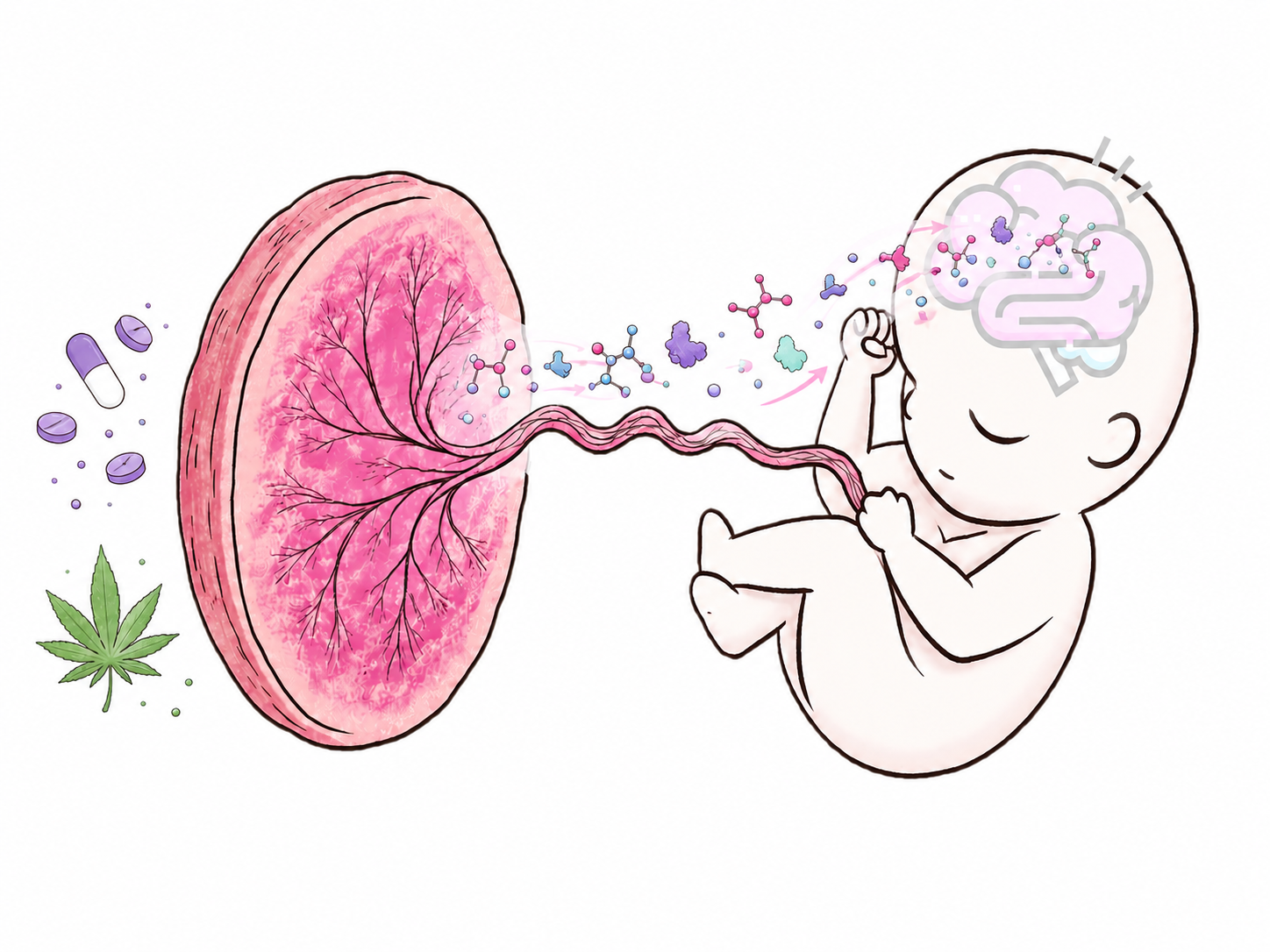
Our previous work showed that prenatal opioid and cannabis exposure can disrupt placental function and contribute to fetal growth restriction. In particular, combined fentanyl and Δ-9-THC exposure appears to alter placental pathways involved in immune response, mitochondrial function, vascular development, and placental efficiency. This project extends those findings by asking whether placental dysfunction is connected to measurable changes in the developing brain.
In simple terms, we are trying to understand whether prenatal drug exposure changes the “message” sent by the placenta to the fetus, and whether opioids and cannabis have additive or interactive effects on shaping neurodevelopmental programming. If the placenta becomes less efficient, inflamed, metabolically altered, or poorly vascularized, the fetal brain may receive different levels of nutrients, oxygen, hormones, inflammatory signals, or growth-related cues. These altered signals may help explain why prenatal substance exposure can lead to changes in brain structure, molecular pathways, and behavior later in life.
A central focus of this work is the placenta–brain axis. The placenta is an active communication hub between the mother and the developing baby. It helps regulate immune signals, metabolism, vascular development, hormones, and nutrient transport. Our research asks: what is the placenta sending, or failing to send, to the fetal brain that may contribute to altered neurodevelopment?
We use global and spatial proteomics to better understand how prenatal exposure changes protein expression in the placenta and brain. Global proteomics provides a broad overview of thousands of proteins, while spatial proteomics allows us to map protein changes within specific brain regions and cell types. Together, these methods help us identify which molecular pathways may link placental dysfunction to altered fetal brain development.
This research aims to provide a more complete understanding of how prenatal opioid and cannabis exposure affects fetal development. By focusing on the placenta–brain axis, we can move beyond describing outcomes and begin identifying mechanisms. Understanding what the placenta communicates to the fetal brain may help reveal early biomarkers of risk, clarify how combined drug exposure alters development, and support future harm-reduction strategies for pregnancies affected by substance exposure.
Ultimately, this work seeks to generate knowledge that can inform prenatal care, patient counseling, and public health approaches. By connecting placental biology with fetal brain development and later behavior, this project may help explain why some exposed offspring are more vulnerable to neurodevelopmental impairments and identify biological pathways that could be targeted for future intervention.
- Centers for Disease Control and Prevention. Polysubstance Use During Pregnancy. Updated May 8, 2025.
- Centers for Disease Control and Prevention. About Opioid Use During Pregnancy. Updated May 1, 2026.
- Balalian AA, Graeve R, Richter M, Fink A, Kielstein H, Martins SS, Philbin MM, Factor-Litvak P. Prenatal exposure to opioids and neurodevelopment in infancy and childhood: a systematic review. Frontiers in Pediatrics. 2023;11:1071889.
- Rosenfeld CS. The Placenta-Brain-Axis. Journal of Neuroscience Research. 2021;99(1):271–283.
- Lewis E, Lee SJ, Park HR. Placenta-derived extracellular vesicles in fetal health: emerging insights into brain development and environmental interactions. Experimental & Molecular Medicine. 2025;57:2729–2738.
- American College of Obstetricians and Gynecologists. Cannabis Use During Pregnancy and Lactation. Clinical Consensus No. 10. October 2025.
- Cariaco et al. Synergistic impact of opioids and Δ-9-THC on altering placental gene expression and fetal growth patterns. Placenta. 2024.
- Cariaco et al. Opioid and cannabis exposure adversely affect fetal and placental growth trajectories in a mouse model of drug consumption during pregnancy. Placenta. 2023.